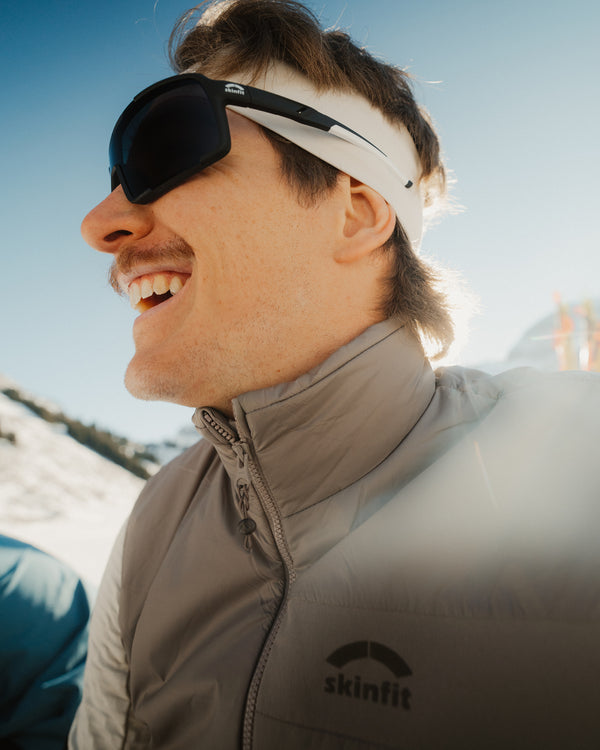
The layering principle involves combining several thin layers of clothing. Each layer has a specific purpose: regulating moisture, retaining warmth, or providing protection against wind and precipitation. Putting on and taking off layers allows you to adapt your outfit to activity levels and weather conditions much faster than with a single thick jacket.
Three tasks instead of one universal jacket
A base layer worn close to the skin handles moisture management. A mid-layer regulates or insulates. An outer layer protects against wind and weather.
Not every tour requires all functions at the same time. This is precisely the advantage of the system.
Greater control over body temperature
During an ascent, a mid-layer can be taken off while the base layer continues its work. On a ridge, wind protection can be added. During a break, an insulation layer provides warmth.
With a single thick jacket, the adjustment is much coarser: wearing it is too warm, taking it off is too cold.
The layers must fit together
The base layer should transport moisture away from the body. The mid-layer must not unnecessarily block this transport. The outer layer requires enough volume and freedom of movement for the layers underneath.
Too many tight layers can compress insulation and impair mobility.
The Skinfit System as an example
Our layering system combines the 3-layer principle with five functional modules: Base Layer, Mid Layer, Insulation Layer, Top Layer, and Pants.
This allows, for example, wind protection to be selected independently of insulation. This is often more precise than a single jacket that combines both to a high degree.
When a thick jacket is still useful
In situations with very low intensity, long periods of standing still, or extreme cold, a heavily insulated jacket can be the best solution. It complements the layering system and is usually put on when activity levels decrease.
The layering principle is not an end in itself. What matters is the appropriate function for the specific situation.
Preparing your layering correctly
Try on the complete combination before embarking on a demanding tour. Check whether your sleeves, shoulders, and hood remain mobile even with several layers on, and whether the outer layer offers sufficient space.
Do not automatically choose the largest possible number of layers. Every additional layer must serve a recognizable function. Otherwise, you will face unnecessary weight, heat buildup, and restricted mobility.
Conclusion
Several thin layers are superior, especially when dealing with changing intensity levels and variable weather. They can be regulated more precisely, used individually, and combined for different types of sports.
Frequently Asked Questions
How many layers does the layering principle include?
Classically three: base, mid, and outer layer. Depending on the conditions, an additional insulation layer may be useful.
Do I always have to wear all layers?
No. They are used depending on movement, temperature, wind, and precipitation.
What is the most important layer?
No single layer works best in isolation all the time. For intensive exercise, a suitable base layer is the foundation.
Why separate wind and warmth layers?
This allows you to dose protection and insulation independently of each other.