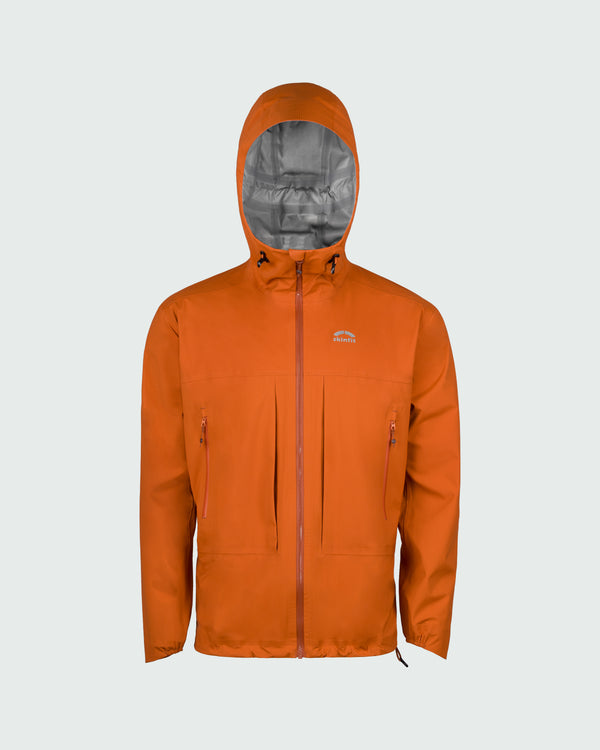
Men's hardshell jackets

For rain, snow, and strong winds in the field, men's hardshell jackets offer waterproof protection, robust construction, and adjustable ventilation. This ensures your outfit performs equally well during training, touring, and competition.

Men's hardshell jackets
19 items

A hardshell jacket is a windproof and waterproof outer layer that protects against precipitation and adverse weather conditions. The word “shell” describes its role as the outermost protective layer. Unlike an insulated jacket, a classic hardshell jacket provides hardly any additional warmth. The insulation you need comes from the layers worn underneath.

A hardshell jacket protects against rain, snow and wind. At the same time, the material is permeable to water vapor, so that some of the moisture generated during exercise can escape to the outside. Depending on the construction, the jacket can be particularly light and packable or designed more for durability. This makes hardshell jackets suitable for a wide range of outdoor activities and weather conditions.

Hardshell jackets are generally designed as a waterproof outer layer. For reliable protection, sealed seams and appropriately finished zippers are just as important as the outer fabric and the membrane. How effective the weather protection is can be seen from the technical details of each model. A water-repellent jacket is not automatically a hardshell jacket.

Hardshell jackets are generally permeable to water vapor. This means that moisture in the form of water vapor can pass through the material to the outside. However, they are not completely air-permeable. During high exertion, more moisture can therefore be generated than the material can transport away. Ventilation openings and well-adapted layering help to further regulate your body climate.

In a 2.5-layer construction, the outer material and membrane are complemented by a thin protective inner coating. Such jackets are often light and packable. In a 3-layer construction, the outer fabric, membrane and inner material are firmly bonded together. This can improve durability and comfort with frequent use. Which construction suits you better depends on the intended use.

For ski touring, a hardshell jacket should offer reliable protection against wind and precipitation while being as light and packable as possible. On intense ascents, water vapor permeability and additional ventilation options are important. The hood should be compatible with the helmet you use. The cut and size must also leave enough room for a Baselayer and insulating Midlayers.

A hardshell jacket is suitable as a protective Outlayer for winter conditions. It keeps out wind, snow and precipitation, but on its own usually provides little insulation. For the necessary warmth, it is combined with a Baselayer and a suitable Midlayer. Some models combine protection and insulation. The specific features are stated in the respective product description.

A hardshell jacket should offer enough room for the layers you need without being unnecessarily loose. Full freedom of movement must be ensured even with a Baselayer and Midlayer. The sleeves, back and hem should provide sufficient coverage during athletic movements. The fit should therefore be checked in a body position typical of the respective sport.

A well-fitting hood protects your head, throat and neck from precipitation and wind. Depending on the use, it can be decisive whether it fits under or over a cycling, climbing or ski helmet. Adjustable hoods can be adapted more precisely to your head and helmet. A brim can help keep rain away from your face. Not every model offers the same construction or adjustability.

Sealed seams and weather-protected zippers help keep moisture out. Adjustable hems on the hood, sleeves and hem improve the fit and reduce wind penetration. Pockets should be accessible even when wearing a backpack or climbing harness. Depending on the use, ventilation openings, reflective elements or a helmet-compatible hood can be useful.

As the Outlayer, the hardshell jacket forms the outermost protective layer. A Baselayer is worn directly on the skin to wick moisture to the outside. In cooler temperatures, an insulating Midlayer completes the outfit. The individual layers are combined depending on the sport, intensity, temperature and weather. This way, warmth and weather protection can be flexibly matched to the conditions.

First consider which sport and weather conditions you need the jacket for. For flexible rain protection, weight and pack size are important. For frequent alpine use, durability, ventilation and a helmet-compatible hood can be decisive. For winter use, there must also be enough room for insulating layers and good freedom of movement. The technical product details help you compare.